



In partnership with

We deliver in-depth research, but your inbox may limit our message. To read the full newsletter, please access it through the EWVC news website 🐝.
Quote of the day: “Energy is the only universal currency: one of its many forms must be transformed to get anything done.” - Vaclav Smil (Energy scientist).
EWVC Academy: Most VC programs explain how funds operate. This one puts you in the driver’s seat 👏🏼
Step into the VC Fund Manager Masterclass, an immersive, high-intensity experience that compresses a full 10–15 year venture fund journey into just three days. You’ll build, launch, and run a fund in real time, making hundreds of investment decisions alongside ambitious peers in a competitive, collaborative environment.

Designed to unlock access and accelerate younger professionals into fund leadership, this programme equips you with LP-grade skills, powerful networks, and the confidence to raise and manage institutional capital.
Join us and be part of the next wave shaping Europe’s venture future!
🎉 If you are interested in exploring event and partnership opportunities with us, please click below to chat with ⭐️Kasia!⭐️
Meet America’s Newest $1B Unicorn

A US startup just hit a $1 billion private valuation, joining billion-dollar private companies like SpaceX, OpenAI, and ByteDance. Unlike those other unicorns, you can invest in EnergyX.
Over 50,000 people already have. So have industry giants like General Motors and POSCO.
Why all the interest? EnergyX’s patented tech can recover up to 3X more lithium than traditional methods. That's a big deal, as demand for lithium is expected to 5X current production levels by 2040. Today, they’re moving toward commercial production, tapping into 100,000+ acres of lithium deposits in Chile, a potential $1.1B annual revenue opportunity at projected market prices.
Right now, you can invest at this pivotal growth stage for $13/share. But only through July 16. Become an early-stage EnergyX shareholder before the deadline.
Energy Exploration Technologies, Inc. (“EnergyX”) has engaged Beehiiv to publish this communication in connection with EnergyX’s ongoing Regulation A offering. Beehiiv has been paid in cash and may receive additional compensation. Beehiiv and/or its affiliates do not currently hold securities of EnergyX.
This compensation and any current or future ownership interest could create a conflict of interest. Please consider this disclosure alongside EnergyX’s offering materials. EnergyX’s Regulation A offering has been qualified by the SEC. Offers and sales may be made only by means of the qualified offering circular. Before investing, carefully review the offering circular, including the risk factors. The offering circular is available at invest.energyx.com/.
Comparisons to other companies are for informational purposes only and should not imply similar results. Past performance is not indicative of future results. Market shortfall are forward‑looking estimates and are subject to substantial uncertainty.
👉 From one bottleneck to another
💡 The AI build-out has stopped being a semiconductor story with an energy footnote. It is now an energy story with a semiconductor input.
In April we argued that the value in AI was migrating down the stack - away from the application layer and toward the compute beneath it: semiconductors, memory, manufacturing equipment, the physical machinery of intelligence. That thesis still holds. But the binding constraint has already moved one layer deeper. It is no longer the chip. It is the electron.
The clearest proof is in what the money is buying. In the first weeks of 2026 the four largest hyperscalers (Amazon, Alphabet, Microsoft and Meta) guided investors to roughly $700 billion of combined capital expenditure this year, close to double their 2025 spend. Microsoft guided to about $190 billion (and flagged that roughly $25 billion of that is component-price inflation, not new capacity). Amazon held its $200 billion February forecast. Alphabet raised guidance to $175–185 billion. Meta guided $115–135 billion. Each of the four now spends more than $100 billion a year, at capital intensity of 45–57% of revenue - levels that would have read as reckless five years ago.

Source: OM
The size of the spend matters less than what it reveals. Microsoft is sitting on an $80 billion backlog of Azure orders it cannot fulfil, and what's holding it back isn't chips, it's power. When a company like Microsoft runs short of power before it runs short of silicon, the bottleneck has plainly moved.
So the question this letter asks is the one April set up: if compute was last year’s scarcity, what is the scarcity now, who controls it, and where does the investable value sit? The answer is the boring, capital-heavy layer almost nobody was modelling a year ago, generation, grid connection, storage, cooling, and the software that orchestrates them.
The demand curve underneath AI 🤖⚡️
The scale is hard to overstate. In its 2026 update to the Energy and AI analysis, the IEA estimates global data-centre electricity use at roughly 485 TWh in 2025 (already comparable to a mid-sized industrial economy) and projects it will roughly double to around 950 TWh by 2030, about 3% of world electricity demand. Crucially, demand from AI-focused data centres triples over that window, growing several times faster than the rest of the sector.
The load is also intensely local. The IEA’s 2025 Energy and AI report notes the United States, China and Europe accounted for about 85% of consumption, and that in the US data centres are on course to consume more electricity by 2030 than the production of aluminium, steel, cement and chemicals combined. Lawrence Berkeley National Laboratory puts US data-centre demand at up to 6.7–12% of national electricity by 2028. In Ireland, data centres already draw over a fifth of national power.

Source: IEA
Demand is doubling on a five-year clock; the grid does not. New high-voltage infrastructure takes the better part of a decade to permit and build. That mismatch (fast, concentrated, inflexible demand meeting slow, shared, capital-rationed supply) is where the entire investment thesis lives.

Source: IEA
🔌 Three ways to power an AI data centre, and why the difference is investable
AI facilities aren't all powered the same way, and the choice of architecture drives everything an investor cares about: cost, how fast it can be switched on, how resilient it is, and how exposed it is to regulators. Three models are competing for the same demand right now, and capital is moving between them in real time.
👉 Model 1: Grid-connected (the incumbent that's running out of room)
All power drawn from the local utility, with diesel or batteries for backup. Still dominant, increasingly constrained. In Europe’s major hubs, interconnection waits now run the better part of a decade, against build times of roughly two years. The grid is not disappearing, but on its own it can no longer keep pace with AI deployment timelines.
👉 Model 2: Behind-the-meter (where the capital is moving fastest)
Generate power on-site and bypass the interconnection queue entirely. McKinsey work cited by Jefferies suggests a quarter to a third of incremental data-centre demand to 2030 could be met behind the meter. A Bloom Energy survey found the share of operators planning to run entirely on on-site power by 2030 jumped from just 1% in 2024 to 27% a year later. The appeal is time-to-power: a behind-the-meter site can be energised years ahead of one waiting in a queue.
The deal flow confirms it. GE Vernova raised full-year guidance in April 2026 on the back of data-centre demand and expects to reach 20 GW of annualised gas-turbine output by Q3, it booked more electrification orders from data centres in Q1 alone than in all of 2025. Brookfield committed up to $5 billion to deploy Bloom Energy’s solid-oxide fuel cells at AI sites. Amazon, Google and Microsoft are each backing small modular nuclear ventures.

Source: Bloom News
👉 Model 3: Hybrid microgrid (the priciest option, and the deepest moat)
Grid plus on-site generation plus storage, knitted together by an intelligent controller that can island during outages, optimise across sources in real time, and sell flexibility back to the utility. The most capital-intensive option, but the software layer that orchestrates multi-source power is the most defensible capability in the stack, and the hardest to commoditise.
Why AI loads break the old playbook 🧠
The thesis only works if you understand why AI loads are structurally unlike anything the grid was built to serve. The differences are not marginal, they reshape the whole energy architecture.
Training runs GPU clusters near maximum utilisation around the clock, for days or months. The load is essentially flat, a load factor near 0.85–0.95 versus 0.3–0.5 for a traditional enterprise facility. That looks like baseload, which utilities like. But a single interruption during a large run can force a restart costing millions, so instantaneous backup is non-negotiable.
Inference is the opposite problem: variable, demand-following, prone to sudden spikes when a model goes viral. It needs not just more power but more flexible power, fast-ramping and peak-absorbing. And large clusters switching together can swing demand by tens of megawatts within seconds, threatening voltage stability on the local grid. Fast-response backup with voltage support stops being a nice-to-have.

Source: Google Cloud via Semianalysis
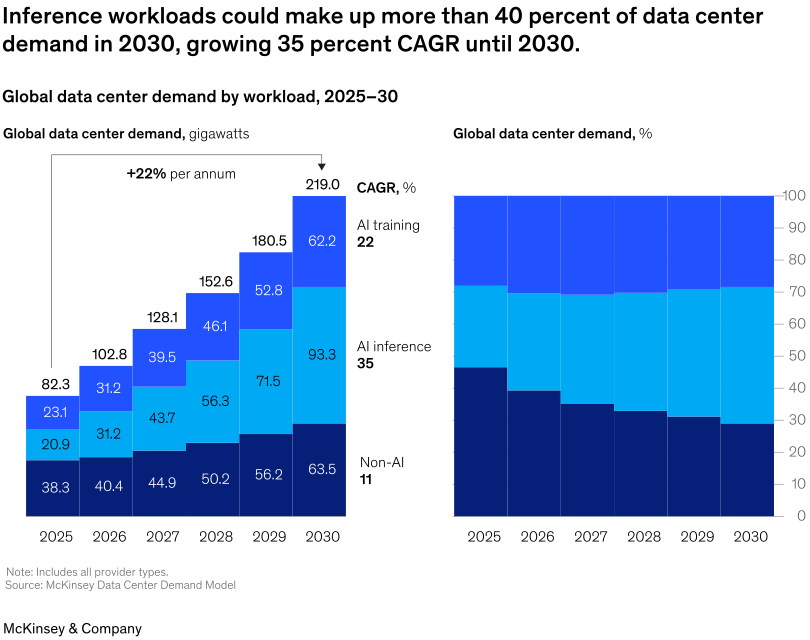
The punchline for the next decade comes from JLL-style sector forecasts: as AI shifts from a training-dominated to an inference-dominated workload, the power profile flips from flat baseload to volatile, spike-prone demand. The energy solutions that win the training era are not automatically the ones that win the inference era.
📊 Global data-centre demand by workload (2025–2030). Inference (35% CAGR) overtakes training by 2029.
Source: McKinsey
🔋 The backup stack is itself an asset class
AI sites don’t just need primary power; they need a layered backup architecture spanning millisecond response to multi-day endurance. Each layer is a distinct market.
Layer 0: Ride-through (milliseconds): capacitors and fast UPS smoothing micro-interruptions.
Layer 1: Bridge (minutes): batteries (BESS) as the critical first responder.
Layer 1b: Extended bridge (up to hours, sub-50ms start): grid-scale BESS - the fastest-growing segment of the stack.
Layer 2: Sustained (days): diesel or gas reciprocating engines - slower to start, effectively unlimited with refuelling.
Layer 3: Endurance logistics: the refuelling chains that keep generators running through prolonged outages.
Think of backup power as a relay race, not a single runner. The moment grid power wobbles, something has to carry the load instantly, then hand off to the next system, and the next, each built for a longer leg of the outage. Capacitors and fast UPS cover the first milliseconds. Batteries take the next few minutes. Grid-scale storage extends that to hours. Generators carry it for days, and behind them sits the fuel-supply chain that keeps those generators running. Each handoff is a distinct piece of equipment, a distinct cost, and a distinct market.
Batteries deserve special attention. They respond in milliseconds, bridge the gap until a generator reaches full output, smooth fast GPU ramp events, and (in utility markets) offset demand charges and earn ancillary-service revenue. Estimates of the data-centre power-systems market vary widely, but one widely-cited forecast puts it at roughly $24 billion in 2026 rising to about $56.5 billion by 2034 (≈16% CAGR), with BESS, fast-start gas and power-management software the fastest-growing pieces. Treat the absolute number with caution - the direction of travel is the signal, not the decimal.
The European question: €176 billion committed, but can the grid take it? 🇪🇺
Europe’s data-centre market is, in the words of the EUDCA’s 2026 State of European Data Centres report, entering a “pivotal phase.” The association forecasts €176 billion of cumulative investment from 2026 to 2031, but warns explicitly that future growth will be capped by grid readiness, not capital. IT power capacity already grew from 10,539 MW (2023) to 14,784 MW (2025), ahead of forecast.
👉 Data centres in Europe by type and IT Power (50 kW or more), 2024

Source: EUDCA
This is the same tension May’s letter drew out in public markets (capital arriving faster than the underlying plumbing can absorb it) now playing out in physical infrastructure. The capital is willing. The grid is the gate.
👉 How is the energy consumption of your data centre(s) approximately divided into the following variants?

Source: EUDCA
The response is geographic. As the traditional FLAP-D hubs (Frankfurt, London, Amsterdam, Paris, Dublin) hit queue and permitting limits, capital is decentralising toward the Nordics (cheap hydro, free cooling), Iberia, Central and Eastern Europe and Tier-2 metros. Ireland has effectively gated new connections on matching dispatchable power; the Netherlands has added zoning limits. Regulation is also tightening efficiency, the EU’s reporting regime and national PUE rules are pushing the market toward cleaner, denser builds faster than in the US.
The risk cuts both ways. The €176 billion forecast assumes the infrastructure can be built. The interconnection data suggests much of it cannot, at least not in the markets where demand is highest. If Europe cannot fix queues and permitting, the capital will simply go elsewhere.
⚠️ Where this thesis breaks
Any honest version of this story names its own failure modes and the most interesting risks are the ones the capital is not yet pricing.
The grid can’t be bypassed forever. Behind-the-meter gas relieves the queue but collides head-on with decarbonisation pledges. The hyperscalers selling net-zero are the same firms ordering gas turbines booked solid through 2028. That tension is unresolved, and it is political as much as technical.
The nuclear timeline is a promise, not a delivery. Every hyperscaler has an SMR commitment; none has operational SMR power at a data centre. Realistic timelines are 3–5 years at best. If one project lands on schedule it resets the market, but betting on schedule has historically been a way to lose money in nuclear.
Community and permitting risk is real and rising. Local opposition, water use and grid-cost socialisation are turning into the binding political constraint in exactly the markets with the most available capacity. Speed-to-power assumptions die in planning hearings.
And the market-size numbers are soft. As the sources above show, estimates for the same market diverge by billions depending on definitions. Underwrite the trend; distrust any single forecast quoted to the decimal.
❗️What this means for VCs and founders
Three layers to keep in mind ⚡️:
🔧 Hardware-adjacent. Turbines, fuel cells, BESS, transformers, switchgear, cooling. The market is real - GE Vernova booked more data-centre electrification orders in Q1 2026 alone than in all of 2025, and transformer lead times have stretched to 128 weeks, but it's incumbents' territory (GE Vernova, Schneider, Eaton, Caterpillar, Bloom). Venture opening: the next generation (solid-state transformers, new battery chemistries, SMRs, advanced liquid cooling) where AI's density demands outrun what current products deliver.
💻 Software and controls. Microgrid controllers, power-management platforms, load optimisation, predictive maintenance, demand-response, energy trading. The data-centre power-systems market is forecast to roughly double from $24bn in 2026 to $56.5bn by 2034, with software the fastest-growing piece. This is where defensible margin lives, orchestrating multi-source power at millisecond response is a venture-scale software problem.
🏗️ Infrastructure services. Site selection, interconnection consulting, behind-the-meter development, power-as-a-service, procurement. With European interconnection waits running 5-10 years and a quarter to a third of incremental data-centre demand to 2030 expected to be served behind the meter, whoever can secure power-ready sites on a compressed timeline captures real value.
👁️ What we are watching next
This is the largest infrastructure cycle since the late-1990s telecoms build, with very different physics underneath. We are watching:
⚡Behind-the-meter adoption: whether the 25–33% forecast survives permitting, community opposition and emissions pledges. The speed-versus-decarbonisation tension is live.
🔋 Grid-scale BESS at data centres: the fastest-growing component. Watch for dedicated data-centre BESS products and co-located storage-plus-generation models.
☢️ Small modular reactors: still 3–5 years out at best. The first on-schedule delivery resets expectations for everyone.
🇪🇺 European grid reform: the €176bn forecast depends on solving interconnection queues. Watch policy in Germany, Ireland, the Netherlands and France.
💻 Power-management software: the least visible, potentially highest-margin layer. Watch for venture-backed entrants.
📊 The inference/training mix: as inference overtakes training, the power profile flips from flat to spiky, changing which solutions win.
The hyperscaler capex numbers make the headlines. The energy infrastructure underneath them makes the returns.
Emerging Female Investor Office Hours 🇬🇧

The British Business Bank has opened applications for its Emerging Female Investor Office Hours.
What's on offer:
→ A free, informal 30-minute 1:1 session with a member of the BBB equity funds team
→ Virtual via Microsoft Teams, open to wherever you're based
→ Your agenda, your questions, your pace
🙌🏼 People who inspired us lately
💥 Hilde Støle Pettersen

Hilde Støle Pettersen is Managing Partner at Momentum, a Bergen-based climate tech fund backing early-stage companies in ocean industries, agriculture, renewables, and construction and energy efficiency. With 850+ MNOK in AUM, she has built Momentum into one of Norway's most respected climate-focused funds, and one of European climate investing's most consequential voices.
👉 Find more about Hilde
💥Katerina Spranger

Katerina Spranger, PhD 🇺🇦 is the Founder and CEO of Oxford Heartbeat and a Fellow of the Royal Academy of Engineering. She aimed to reshape how the world's most complex surgeries are performed and the accolades are finally catching up with her vision.
On 4 June 2026, she was named the overall winner of the EU Prize for Women Innovators 2026 by the European Commission's EIC - European Innovation Council at the EIC Summit in Brussels! 👏
👉 Find more about Katerina
💥Jenny Ruth Hrafnsdottir

Jenny Ruth Hrafnsdottir is a Founding Partner at Crowberry Capital, a Nordic venture capital firm with offices in Reykjavík, Copenhagen and Stockholm, investing in seed and early-stage tech startups with a mission to back people that are good for companies and build companies that are good for people. From Iceland, she is quietly reshaping who gets funded and who gets to decide.👏
👉 Find more about Jenny
💥Yasmin Razavi

Yasmin Razavi is a General Partner at Spark Capital and a phenomenal force in global tech investing. Back in 2023, when most traditional VCs hesitated to back Anthropic because it had no public product or revenue, Yasmin saw the team’s undeniable genius. She led a $450 million round that valued the company at $5 billion. Her legendary conviction in the future of AI has just landed her on the Forbes Midas List for the very first time.👏
👉 Find more about Yasmin
Inside Bpifrance’s Strategy to Power France’s Tech Ecosystem

We sat down with Adeline Lemaire, Executive Director and Head of Funds Investments at Bpifrance, to discuss:
The Strategy: How they manage €21.5B in AUM across the funds of funds division and how they back successor funds selectively across 230+ GP relationships.
Beating the Crunch: Navigating the current liquidity and fundraising slowdown in European VC.
The Diversity Mandate: Driving female partnership representation across their portfolio by 2030.
👉Read the full interview here
🤑 Latest Fund News
THENA Capital closes £45 million inaugural fund and backs five UK MedTech companies 👏🏼

THENA Capital (co-founded and led by Esther Reynal de St Michel Richardot, Dr Pamela Walker Geddes and Tatum Yount Getty has announced the final close of Fund I at £45 million ($60.4m), backing early-stage UK MedTech with transatlantic ambitions. A few reasons this one stands out:
✨ A first of its kind. Anchored by the British Business Bank's Enterprise Capital Funds programme, THENA is the first all-female GP-led fund ever to receive ECF backing - a structural breakthrough for UK venture.
✨ A female-majority LP base. More than half of the fund's limited partners are women, including Baroness Martha Lane Fox (Lastminute.com), Mirjam Staub-Bisang (Chair, BlackRock Switzerland), and senior executives from GSK, Novartis, AstraZeneca, GHO Capital, Carlyle and TA Associates.
✨ Already deploying. Five investments completed in year one (Plexāā, Salient Bio, Sanome, Heim Health and Zonova) with early milestones including a Mayo Clinic collaboration, MHRA CE-marked IVD status, and selection for the 2026 NHS Innovation Accelerator. Fund I targets ~25 companies, cheques of £500k–£1m, Seed-stage digital health and medical devices.
👉 Read the full announcement here
Frontier Health raises $16M to point AI at the NHS’s paperwork!

Industry: AI / HealthTech | Location: 🇬🇧 London | Funding: $16m
London-based Frontier Health, founded in 2024 by former Palantir healthcare lead Rachel Finegold, raised a $16 million seed led by Atomico, with firstminute capital and XYZ Venture Capital also participating.
👉 Read more here
Seedcamp closing $320M in new capital!

Huge congrats to Seedcamp team led by Reshma Sohoni and Carlos Eduardo Espinal on closing $320M in new capital! 🚀
• $220M Seedcamp VII - first-cheque Pre-Seed/Seed investments
• $100M Select Fund - follow-on through Series B and beyond
Founded in 2007 with just $2.5M, the London-based firm has backed some of Europe's most iconic companies: Revolut, Wise, UiPath, Synthesia, and Fluidstack.
👉 Read more here
New Fund in Romania - Nucleo Ventures 🇷🇴

Nucleo Ventures team combines the perspectives founders need early: enterprise software, venture building, financial discipline, legal structuring, brand, AI and go-to-market support.
Congratulations Irina Misca, Alexandru Chifu, Valentin Filip and Sorin Badulescu. We can’t wait to hear about your successes!
👉 Read more here
What we are reading! 📖
🇪🇺 'Europe 2031' - what getting AI wrong could cost us
A five-year scenario tracing how Europe slides into strategic irrelevance if it misjudges AI, told through a Brussels policy worker and a German founder who has decamped to Silicon Valley. Uncomfortable reading - precisely because the early chapters are grounded in events that have already happened. Its hardest argument is the one this letter keeps circling: the constraint is physical (compute, power, supply chains), and the window to build leverage closes faster than institutions move. - thank you to Judith Dada.
👉 Read more here
🌱 Planet A's 2025 Impact Report
Lena Thiede and the team at Planet A Ventures have published their 2025 Impact Report - the first European VC to make scientific sustainability assessment a mandatory part of investment decisions. In-house scientists run life-cycle analyses and can veto deals on impact grounds. With Fund I (€160m) actively deploying, it's a rare example of impact measured rigorously rather than asserted - and a strong reference point for any fund thinking about how to make impact genuinely investable.
👉 Read the report here
🚀 Anatomy of the largest IPO in history: the SpaceX S-1
Artur Kurasiński's deep dive (in Polish - worth a translation) dissects a prospectus targeting a $1.75 trillion valuation and an offer of up to $75bn - the largest US listing ever. Strip away Mars and orbital data centres and what's left is Starlink: 10.3m subscribers across 164 countries, astronomical margins, wrapped in $20bn of bridge financing refinancing debt inherited from X and xAI. At 243x EBITDA, he argues, you're not buying an internet operator - you're buying a bet that Musk converts ambition into cash. Worth reading as OpenAI, Anthropic, Databricks, Stripe and Canva all line up behind it.
👉 Read more here
Nur Özdemir joins the NATO Innovation Fund 💥
Nur Özdemir (ex European Investment Fund) has joined the NATO Innovation Fund to run its fund-of-funds programme. It is a significant LP-side appointment: the NIF is one of Europe's most strategically important deep-tech and dual-use backers, and putting an experienced EIB/EIF allocator in charge of its fund commitments is a strong signal for European GPs raising into the defence, security and resilience theme.
👉 Read more here
Together with AGX venture fund, lead by Iwona Cymerman and Filip Vurdelja, Venture Connections and European Women in VC delivered the first ever Tech Stack Report. The feedback has been excellent! Dive in here :
What we are up to! 🎉
🔵Beyond Horizon: Towards a new era of integrated European competitiveness? | June 2nd, 🇧🇪 Brussels

This month, Kinga Stanisławska took the stage at the European Parliament at Beyond Horizon, a Science | Business conference on European competitiveness.
Three takeaways that matter for our ecosystem:
Europe's problem isn't a lack of capital, it's a lack of plumbing. Pension rules and fragmented markets keep savings away from innovation. The Savings & Investments Union must be built with teeth, not diluted in trilogue.
The EU-INC risks being harmonisation in name only. Article 4 of the current proposal fills every gap with national law - effectively recreating 27 regimes. Parliament has the chance to fix this. It should.
Central and Eastern Europe is not peripheral to this story. 🇵🇱Poland built a VC market, produced a decacorn in ElevenLabs, and sends engineers to the world's top AI labs. The talent pipeline works. The capital architecture that retains it doesn't yet.
👉 Find more here
🔵 EIC Summit | June 3rd and 4th, 🇧🇪 Brussels


🔵 SuperReturn Venture | June 8-10th, 🇩🇪 Berlin

🔵 LP-GP Lunch | Women & Men Allies in VC, Berlin 🙏

To everyone who joined us at the LP-GP Lunch | Women & Men Allies in VC in Berlin during SuperReturn week: thank you! The two hours we shared brought exactly the kind of honest, unhurried dialogue that is so rare in a week that packed, and that was entirely down to the people in the room.
🔵 Reuters Events: Investment London 2026 🇬🇧

On 16 June, Reuters Events: Investment London 2026 convened over 300 senior asset owners, asset managers and private-capital leaders at Convene Sancroft, St Paul's, for the inaugural edition of what is designed to be Europe's most curated LP-GP room, an LP-heavy gathering (around 60% allocators) built for matchmaking, candid roundtables and live deal flow.
🔵 London Tech Week | June 8-12th, 🇬🇧 London

Attend one of our partners’ events 🎟️
🔵Benelux Private Markets Meeting, 16th July, Brussels - 20% discount: CARMO20.
🔵 Global Wealth Management Summit, 4th-5th November, London.
🔵SuperReturn Europe, 3rd-6th November, Amsterdam - 10% discount code: FKR3673EWVC or click here.
🔵 SuperReturn Secondaries North America, 17th-18th November, New York City - 10% discount code: FKR3675EWVC or click here.
⭐️ Scala Academy 👩🏼🦰🦸🏽♀️👩🏻🎓
Know a young woman with a big idea? Send her to Scala Academy: the European learning platform built for female founders under 26 - to sign up.
Scala Academy 👩🏼🦰🦸🏽♀️👩🏻🎓 - Startup Education for Young Female Founders in Europe
Self-paced startup education for female founders under 26 across Europe. Complete the U26 Fellowship at your own pace, earn a certificate, and join a community of young women building real companies. First lesson free.

We're a squad of over 1000 senior female venture capital. We're here to engage allies and make things right.
Join us in shaking up the VC world! 🚀
Take care! 👏🏼